
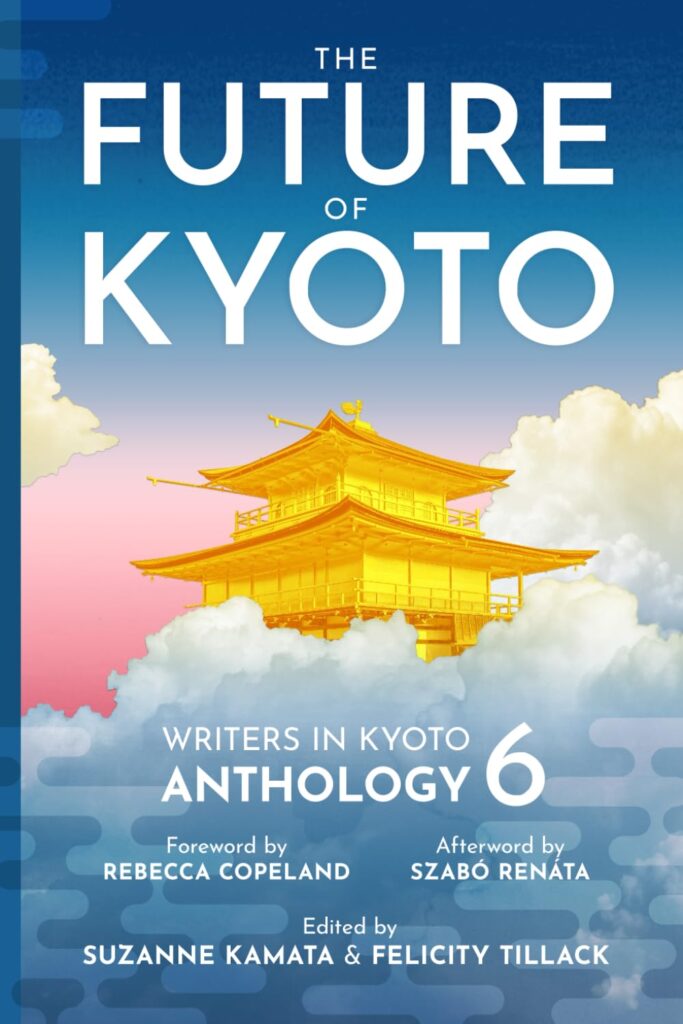
© Michael J. Freiling, 2025. All rights reserved. Permission to publish brief quotes or excerpts is hereby granted, provided the quote or passage is attributed as follows: “Michael Freiling, in Angels Watching Over Us”. This article originally appeared in The Future of Kyoto: Writers in Kyoto Anthology #6 (https://www.amazon.co.jp/Future-Kyoto-Writers-Anthology/dp/B0FS2SCXC6), published by Writers in Kyoto, September, 2025.
____________________________________________________________________________
Prognostication has always been a risky business. Among a practically infinite array of possible future scenarios, your chances of choosing the one that is “right,” or even one that is approximately correct, seem vanishingly small. There is a better chance that your selections will prove wrong, quite wrong.
Deliriously wrong sometimes, as with Lord Kelvin’s 1900 prediction, on the eve of the discovery of the quantum, that physics was now “complete,” and all that remained was the mopping-up exercise of making ever more precise measurements of well-understood phenomena, and adding a few significant digits to the constants that governed the structure of this ostensibly Newtonian universe1. Fortunately for the rest of us, our incorrect predictions are rarely granted such notoriety.
If we must prognosticate, then, what can we do to reduce the risk, even if just marginally? One idea comes to mind—to try to answer questions about the future by looking at the past.
What has changed and what has not changed? Do the changes we have already seen offer any clues as to what changes we might expect to see in the future? In this I am perhaps uniquely positioned. I first came to Japan in 1977 as a Luce Scholar to work as a postdoc in AI at Kyoto University (yes, people were working on AI way back then). That was almost exactly 50 years ago—48 to be precise. But after that scholarship year I was unable to return to Kyoto, other than a few short business trips, until 2014.
This was unfortunate in many respects, but it did offer a singular perspective. Being gone for some 37 years, it was relatively easy to spot what had changed and what had not. The task would have been far more difficult if I had been living in Kyoto continuously as the changes occurred incrementally, even imperceptibly.
In this essay I will try to identify the changes and trends I have witnessed over the last 50 years, and ask if they are likely to continue over the next 50. My observations are necessarily anecdotal, of course, so you are entitled to take them with as many grains of salt as you wish.
The Physical Environment of Kyoto
Physically, the changes have been many. The most remarkable, of course, was the new subway system that became operational in the early 1980s. Prior to that, the Keihan Railway operated light rail trains that ran along street level, from Keihan Sanjo through Higashiyama and Keage, stopping at nearly forgotten spots like Kujoyama and Hinooka, then Misasagi, on the way to Yamashina.
I would get on at Hinooka, just downhill from Kyoto University’s International Student Dormitory nestled along the Lake Biwa Canal. Keihan Sanjo was the terminus. The train would pull into a picturesque barn-like structure, unload, and pick up passengers for the return trip to Yamashina and beyond. Today, Sanjo Keihan (the names were reversed at some point) is now a modern subway station on the Tozai line, and the only vestiges of the past are the four-car Keishin trains that stop at their own Keihan Yamashina station on the way out to Lake Biwa. One never realizes at the time of the experience that one’s setting is picturesque or nostalgic, only afterwards.
This is the paradox of nostalgia.
Many other physical changes have taken place. The Keihan line from Osaka was extended out to Demachiyanagi. Buildings have sprouted up all over. My old dorm, where a Swiss student named Alberto used to pitch softball games in his military-style high school tunic, is now housing for a much more sedate crowd—married students according to one account, students from China according to another.
Yamashina itself has become a bustling suburban center, sporting up-to-date stores like Muji, Nitori, and Uniqlo. What I remember was something of a quiet, almost deserted feeling, with many undeveloped or barely developed lots. The area has earned a measure of respect after centuries of association with seediness and disrepute, from the early 1700s when Yuranosuke’s (leader of the 47 Ronin) drunken dissipation went on to become the stuff of legend.
If you’ve seen Kurosawa’s movie adaptation of Rashomon, you may have noticed that the robbery and murder at the heart of the story are set along the road to Yamashina. Even as late as 2013, Takayuki Ohigashi, president of the Gyoza no Osho fast food chain was assassinated in a yakuza-style execution just outside his office.
Restaurants have come and gone over these 48 years. I used to sneak down to Kawaramachi at lunch time to Trecca Pizza (improbably, ika pizza was my favorite). The nameless double-wide chuka-ryori at Hyakumanben was another favorite that has disappeared, although the appetite of Kyodai students for subuta and yaki meshi appears undimmed—a single-width Osho now stands on about half the spot.
Some restaurants have remained, although the names have changed. The Asahi Beer Garden on Kawaramachi is memorable as the site of my first date with a woman I would marry a mere 43 years later. It is still standing, marked by the signature 3-foot-tall beer stein in the window, although the name was recently updated to “Beer Thirty.”
Neighborhood grocery stores are mostly a thing of the past, replaced by an infestation of combini. You can still find the old Japanese-style corner coffee shops with their smoke-filled interiors and stacks of manga, but the customers are meager compared to the swarms at American-style shops like Starbucks and Tully’s. There is even a huge Starbucks at the west end of the romantic Sanjo Bridge, which strikes me as nothing short of sacrilegious.
The People of Kyoto
The people of Kyoto appear to be changing, too. I don’t have statistics on this, just more anecdotal observations. Again, please take them with a grain of salt.
To begin with, the faces I see as I walk down Kawaramachi or Shijo seem much less homogeneous than they did in 1977. Maybe I’ve just learned to detect more subtle differences, but it does seem like the Japanese have become, well, less Japanese. More faces appear to come from other parts of Asia. More faces appear to have mixed ethnicity. And don’t get me started on the tourists. Foreigners, even in the downtown area, were a relatively rare sight in those days, and one was as likely as not to have seen them before.
Certain sorts of people that I saw in 1977 are seen much less frequently nowadays. The old obasan, in a kimono of coarse cloth and muted colors, bent over from years tending to the rice fields, are rarely seen. Ditto the “salaryman,” that post-war aberration, stiff as a ramrod on the morning train to work, but happily bleary on the train home. Or maybe I don’t see them because I tend to take the train home much earlier than I used to.
The salaryman governed his household like an absentee landlord. Rarely seen around the house during daylight hours, he would pad in around 10 pm or later for a bowl of noodles and bed. Even on Sundays, he was as likely to be out playing golf with his business associates as putting in anything that resembled “family time.”
That is one thing that has definitely changed for the better. The newer generation of Japanese fathers, as far as I can tell, are unconflicted family men, working on projects with their children, taking them to the zoo or the aquarium, or practicing road safety with their little bicycles at Takaragaike. Even an occasional date night with one’s spouse is not unheard of, a change that is positively revolutionary compared with 1977.
On the pre-marital end of things, however, dating and marriage have become more of a challenge. The old o-miai system, with its formal supervision of courting and its heavy involvement by many family members, has disappeared in stages. There is still the occasional yenta who undertakes an introduction or two when it seems warranted, but then the kids are told to contact each other, arrange a first date, and figure things out for themselves.
Even figuring things out for themselves is not so simple anymore. Many young Japanese of marriageable age have given up on dating, content to live out their lives as single people. Some cite the difficulty of meeting anybody suitable. Some cite a bad first (or second) experience. Some (especially women) say that a Japanese-style marriage is not a good deal for them. Some say they simply don’t have the “energy” for it. You hear that word “energy” frequently in this regard.
There are, of course, numerous attempts to remedy the situation, from hiking clubs and craft classes to organizations dedicated explicitly to finding partners. Speed-dating has even arrived in Kyoto. But whatever the reasons, suitable replacements for the o-miai system have yet to be found, and this definitely poses a challenge for the future of the Japanese population.
The Language of Kyoto
The erosion of traditional culture, increasing heterogeneity, and increasing individualism also find reflection in the language and communication styles of Kyoto. One rarely if ever hears the very traditional Kyoto expressions like oideyasu or ooki-ni in stores or restaurants. In fact, it seems like the entire Japanese language, at least the way it is used on the street, has become plainer, more perfunctory, more functional. Daijobu has become an all-purpose term that has gobbled up many a more delicate expression of acquiescence, acceptance, or indulgence.
The traditional registers of polite discourse, like -orimasu are heard less frequently. Even the hallowed itadakimashite has been contracted to itadaite. When I arrived back in 2014, I was told by more than one Japanese person that I spoke a “formal and traditional” form of Japanese, as improbable as that might seem after an absence of just 37 years. That’s how much the language has changed.
While Japanese usage continues to evolve, other languages are making inroads. Buses and subways announce their stops in four languages—Japanese, English, Korean and Chinese. Something like that would have been unthinkable in 1977, when the primary role of English seemed to be merely to add a dash of panache to the atmosphere, such as an ad for the exciting “Lake Biwa Boat Laces,” or the “Foxy Grandma” shopping bags I remember.
Human Interaction
Human interactions also seem to have followed the drift toward the perfunctory and the functional. In 1977, most of my meals were taken in small establishments where I could scan the display of plastic dishes outside and order from a waiter, even if it meant dragging them outside to show them exactly what I wanted. The plastic models appear to have mostly moved inside, into the shopping malls.
Today, I’d better be able to read the name of the food next to a button and pay into the machine in many locations. No human contact is necessary, except for a waiter quickly placing the dish in front of me.
Some New Year’s observances are changing and some are not. Even as early as the 1970s, the traditional New Year’s Day open house was more likely to be observed among nisei and sansei Japanese Americans in my native San Francisco than it was in Kyoto. Hatsumode is still regularly practiced, however. Heian Jingu and Fushimi Inari seem to be big favorites among the families I know.
But the tradition of sending nenga-jo, or New Year’s cards, is waning. My late father-in-law regularly sent out as many as 700 to 800. His children’s cards numbered roughly between 50 and 200, depending on their occupation. And the next generation shows signs of skipping the practice altogether, in favor of e-mails. Again, we see the triumph of the perfunctory and the functional.
The Dress Code of Kyoto
Other examples of the trend toward the perfunctory and the functional can be found in the way people dress in Kyoto. Even in 1977, one did not see as many people in formal business attire as one might see in Tokyo, but now one sees even fewer. I have the impression, however, that women make up a significantly higher percentage of the people wearing formal business attire than one saw in 1978.
Riding the subway line often provides the opportunity to make a more leisurely study of sartorial styles. As the population has aged, one tends to see many who wear garb signaling their status as retirees—hiking clothes, loose jeans, and a variety of hats. Younger people seem to be spread across the spectrum, from the latest fashions on Saturday night to extremely casual. Ultra-casual clothing, such as t-shirts or shorts, is still a rarity among the Japanese. One marked change is in the style of uniforms for high school boys. In 1977, their uniforms made them look like military cadets, buttoned up in tunics with stiff collars (like the one Alberto used to wear, even when playing softball) and cadet-style caps. Such uniforms can occasionally be glimpsed around Kyoto, but most often on students visiting Kyoto on a field trip. Blazers and ties have become the order of the day. I haven’t noticed too much change in the uniforms of high school girls, other than the fact that some of them have been updated to more fashionable color schemes.
What Is Likely to Change
So what does the future of Kyoto hold in store? I see no reason why most of the trends I have mentioned will not persist. The population will continue to become more heterogeneous, albeit slowly. The nuances of the language, especially in the area of politeness, are likely to continue to fall by the wayside. The population will enjoy increased leisure and longevity, at least for a time. Dress, I suspect, will continue to become less formal.
Automation in the service industries will continue to increase significantly. I expect Japan to be the first nation in which AI pets and companions for its aging population come into widespread use.
Extrapolating current trends, of course, can only take us so far. It’s easy to predict the continuation of trends that are already in place. But new trends will also emerge. Some of these may appear as logical continuations of current trends. For example, I fully expect to see the language incorporate more terms from a Japanese version of the “text lex,” like the OMG, GTG, BTW, and LMAO now common in the US. I also expect the city of Kyoto to institute additional measures to manage and control the explosion of tourism, like the new tourist-friendly bus routes and recent restrictions on tourist access and photography in the Gion district.
Other current trends may bottom out and even reverse themselves. Hopefully that will be the case with population decline. Japan’s estimated fertility rate increased from 1.20 to 1.23 over the past year—not exactly an overwhelming rebound, but perhaps a leading indicator. I know several families in Kyoto who have managed to have 3 or even 4 children. Government policies are helping. But something will need to be done about the dating and marriage conundrum, and the “energy” levels of its younger population.
What Will Not Change
Some things I do not expect to change. Because they haven’t changed in the past 50 years.
Because they haven’t changed in the past 500 years. The first is the simple fact that Kyoto is less a physical location than a state of mind. Consider Basho’s famous haiku:
kyo nite mo kyo natsukashi ya hototogisu
even in Kyoto on hearing the cuckoo’s cry I long for Kyoto
Basho poignantly articulates the difference between the Kyoto of the material world, and the Kyoto of the mind and spirit. Even situated in physical Kyoto, a grasp of the Kyoto of the spirit can remain elusive.
But just as it can prove elusive in the midst of the Kyoto of the material world, the Kyoto of the spirit can also extend far beyond the city’s physical boundaries, beyond the boundaries even of Japan itself. Some 250 years after Basho’s haiku, this senryu poem was penned by Hisako Saito:
shuugosho sumeba miyako to iu kanji 2
Assembly Center — where I live feels like it has become the capital
This senryu wasn’t written in Kyoto, or even Japan. It was written in Portland, Oregon, in what was essentially a prison, ironically euphemized as the “Portland Assembly Center.” The expression sumeba miyako (literally, “where you live is the capital”) is a common Japanese expression, to encourage you to make the most out of where you find yourself, by making it “the capital.” Scholars might debate exactly which capital is being referred to, but it’s an unavoidable fact that for about 1,000 years of Japanese history, far longer than any other location, Miyako meant Kyoto.
When her fellow prisoners heard Saito recite this poem at the senryu-kai where it was introduced, less than 75 years had passed since the emperor departed from Kyoto. I find it impossible to imagine that their thoughts did not turn to the ancient Heian capital, and that this Kyoto of the spirit helped them gather the energy to survive in the Assembly Center, and in the internment camps that were to come after.
But how does this Kyoto of the spirit persist from century to century? Especially when nearly all of the physical trappings of the Heian Period vanished long ago? This brings us to the second element of Kyoto that I do not expect to change. It is my conviction, however unorthodox, that the Kyoto of the spirit is brought forth and protected in each generation by the spirits of Kyoto.
A few years ago, I was at a dinner party in my old Hinooka neighborhood. The guest of honor was a native of Kyoto who had moved to London and made a success in the accounting and consulting world. As with many Japanese, he was curious about what a foreigner might think. So he asked me point blank “What’s the most unexpected thing you’ve encountered in Kyoto?”
Had he asked me a more conventional question, say, “What do you like best about Kyoto?” I would likely have responded with the usual litany of my favorite tourist spots. But in that relaxed and convivial moment, I was caught completely off guard. The unusual way in which he phrased the question set my mind on a different track. After a moment’s reflection, I replied unselfconsciously, “It’s the ghosts.”
His eyebrows shot up in surprise, and all he could manage to say was, “WHAT?” I found myself on my back heel, forced to explain thoughts and emotions that until that moment had been held privately. I hadn’t met ghosts like this anywhere else in the world, least of all in my native USA.
I met my first ghost in 1977, while jogging along the Lake Biwa Canal. I didn’t even know it was a ghost at the time—just that an eerie feeling overtook me as I passed a certain spot. It wasn’t until I asked some of the local residents about this that I learned a little child had drowned several years earlier at roughly that same spot.
I’ve met other ghosts over time, including Michizane and Lady Murasaki. I don’t go looking for them, of course, but chance encounters can and do occur. These are not like the fearsome yokai of legend. Some of the ghosts I have met are those of distinct personages whose history and ultimate destiny are inextricably linked with Kyoto. Others are ordinary people who lived out ordinary lives. Once, as my plane descended on a trip back from the US, I thought I could feel a whole chorus of spirits (or maybe it was the spirit of the land itself), whispering o-kaeri as my plane descended.
Some ghosts I haven’t met. Nobunaga, who committed seppuku at Honno-ji. Murasaki’s bitter rival Sei Shonagon has never appeared to try and woo me away from Murasaki—at least not yet. I’ve never encountered a male member of the Fujiwara clan (Murasaki was a distant cousin) who might try to make excuses for the way Michizane was treated. I never encountered Shotoku Taishi, although legend has it that Shinran did have an encounter with him at Rokkaku-do.
Some, though not all of the ghosts I’ve met have been designated as kami, and installed at one Shinto shrine or another. And that’s something we need to talk about. When the West first encountered Japan, the term kami was initially translated as “deity” or “god,” and the translation stuck. A lot of mischief was engendered by this mistranslation.
As if we could cram the fluid intuitions of Shinto into a Procrustean bed of sharply delineated Aristotelian and Thomistic categories. If one insists on lumping together all the kami into a single category, it is much more appropriate, both linguistically and philosophically, to use a term like “spirits” or even “angels.”
These angels are real, even as they are not material. Not being material, the costumes in which they manifest can be thought of as Heisenbergian3—they adapt to the intentions and intuitions of the seeker. A devout Shinto believer like Kurozumi Munetada is more likely to find the goddess Amaterasu, while devout Buddhists like Nichiren or Kobo Daishi will more likely meet Kannon. But who is to say they are not meeting the same spirit, albeit in different garb? It’s not their names that matter, it’s the spiritual energy they project4.
In my own life, I’ve learned to have conversations with the spirits I encounter. Often they have provided advice that proved to be extremely valuable. In one particular case, I am convinced they helped create the conditions for an occurrence that could only be described as miraculous. But that’s a story for another time. They have never once shown any reserve, or even so much as remarked upon the fact that I am a foreigner.
I credit these kami with protecting and preserving Kyoto down through the ages—the Kyoto of the material world as well as the Kyoto of the spirit. Perhaps they were responsible for ensuring that Kyoto was spared much of the conventional bombing in World War II, and omitted from the list of nuclear targets at its end. Perhaps these angels of Kyoto inspired Hisako Saito, and through her sumeba miyako provided spiritual sustenance to her compatriots, which helped them endure the camps and thrive afterwards.
Being kami, these spirits (at least as far as I know) are not on any sort of schedule that will force them to be elsewhere 50 years from now. They will still be here, watching over us—foreigner and Japanese alike, providing assistance to those who are willing to listen and believe, to those who love Kyoto. Fifty years hence, they will still be here.
And I—if I am granted the grace (from whence I dare not ask)—I will be one of them.
______________________________________________________________________________
NOTES:
- Sir Isaac Newton (1643–1727) was a mathematician and physicist who developed calculus and formulated a theory of the motion of physical objects that became the basis for “classical” or “Newtonian” physics, which was assumed for a time to account for nearly all physical behavior in a comfortably deterministic model. Beginning in the late 19th century, however, new experiments raised the possibility of troubling and counterintuitive phenomena like non-determinism and action at a distance. New theories were required, such as relativity and quantum physics. More than a hundred years later, science is still struggling to grapple with the challenge of providing coherent and intelligible interpretations of these startling discoveries.
- 2. Baker-Gard, S.; Freiling, M; and Takikawa, S; They Never Asked: Senryu Poetry from the World War II Portland Assembly Center; Oregon State University Press; Corvallis, OR; 2023.
- Werner Heisenberg (1901–1976) was a theoretical physicist of the quantum era who formulated one of the troubling discoveries referred to in note 1 above, which came to be called the Heisenberg Uncertainty Principle. The essence of his formulation is that if you look for one characteristic of the quantum world (say a particle’s position) you can find it, but only at the cost of learning less about other characteristics (e.g. its momentum). For our purposes, the term “Heisenbergian” describes a parallel characteristic of the world of the spirit—if you go looking for a kami, you are more likely to find a kami than to find a bodhisattva. If you go looking for a bodhisattva, you are more likely to find one than to find a kami.
- For more on this topic, see https://shimenawa.org/nature-of-the-transcendent/citizens-of-heaven/.
______________________________________________________________________________
GLOSSARY
Bodhisattva. A Buddhist spirit who has delayed their final enlightenment in order to help other souls advance spiritually.
Chuka-ryori. Japanese version of Chinese food. Often used to characterize restaurants who serve that food.
Combini. Modern convenience store, such as Seven-Eleven. Combini play a much greater role in Japanese retailing than they do in the US.
Daijobu. A sort of all-purpose expression indicating that the current situation is “ok”, “alright”, or “no problem”.
Hatsumode. The tradition of visiting a Shinto shrine or Buddhist temple during the first few days of the New Year in order to pay one’s respects to the Transcendent.
Ika. Japanese word for squid.
Itadakimashite. Very polite Japanese word indicating respect for someone who gives you something or does you a favor.
Kami. Shinto term for spirits venerated at Shinto shrines. Kami come in many forms from the aethereal creator spirits who brought the world into existence, to mythological gods and goddesses, to human beings who have come to be venerated, to the spirits of nature like mountains and rivers.
Kyodai. Colloquial term for Kyoto University (Kyoto Daigaku)
Manga. Japanese illustrated comic books or graphic novels.
Miyako. Literally “the capital”. During the Heian Period, the term miyako was essentially synonymous with Kyoto, or Heian Kyo as it was formally referred to.
Nenga-jo. Traditional New Year’s postcards sent to family, friends, and business associates.
Nisei. Second generation Japanese-Americans.
Obasan. Can mean “aunt” or “grandma”, depending on the length of the vowel. Generally used as a respectful term for an older woman.
Oideyasu. Kyoto dialect for “welcome”, roughly equivalent to the more standard irrashaimasse.
O-kaeri. Traditional Japanese greeting to a household member on their return home.
O-miai. Introduction between a boy and a girl, as the first step toward a traditional Japanese marriage.
Ooki-ni. Kyoto dialect for “thank you”, roughly equivalent to arigato.
Orimasu. Humble and respectful form of the verb “to be” when applied to one’s self.
Sansei. Third generation Japanese-Americans.
Senryu. Senryu poems are similar to haiku in that they have a 5-7-5 syllabic structure, with a focus on human behavior and the human condition rather than nature.
Senryu-kai. A gathering to write and exchange senryu poems.
Subuta. Japanese version of Chinese sweet and sour pork.
Sumeba miyako. “If you live there, it is the capital.” An expression intended to encourage the listener to accept their current situation and make the most of it.
Yokai. Ghosts in Japanese stories, often fearsome and scary.
Yaki-meshi. Japanese version of Chinese fried rice. Sometimes called cha han.
______________________________________________________________________________