
With the 2013 publication of the DSM-V1, the American Psychiatric Association (APA) eliminated the term “Asperger’s” as a diagnostic category, replacing it with the more scientific sounding “Level 1 Autism Spectrum Disorder (ASD),” referring to the degree of support a person needs to function in society. At level 1, some support is required, but not as much as level 2 or level 3. Support can include social assistance (e.g. reminders, coaching) or more structured accommodations in the classroom or workplace.
There is no reason, of course, to believe that the ASD population sorts itself neatly into levels. More likely, it represents a continuum — one that can extend downward to a level where support, as the APA defines it, is no longer necessary, and the subject is no longer of diagnostic interest.
Despite being able to function without support, the person may still face challenges similar to those found at higher levels. Such challenges primarily center around difficulties with social interaction — understanding the emotions of others, reading social cues, and responding appropriately.
What does the social world look like to these “Aspies” (as they like to call themselves)? I can speak from first-person knowledge, having recently been diagnosed as an Aspie myself. The history of interactions that led to my discovery began way back in the fifth grade, when my teacher asked me “Why can’t you just be normal?” It was concluded just last year. I can’t tell you what a relief it was to learn that, after all, I was not prey to some dark “personality disorder” as some had maintained — just an ordinary, everyday Aspie.
So what does the social world look like to us? Aspies tend to feel safest when following a set of well-defined rules. Without them, we tend to feel cut adrift. The social world appears as a place where everybody else has received a copy of the rulebook. Except us. We observe others appearing to follow the rules effortlessly, and we frequently feel the sting of disapproval when we unknowingly violate them. Not grasping the rules instinctively, we are forced to launch ourselves on a desperate quest to figure them out by any means at our disposal.
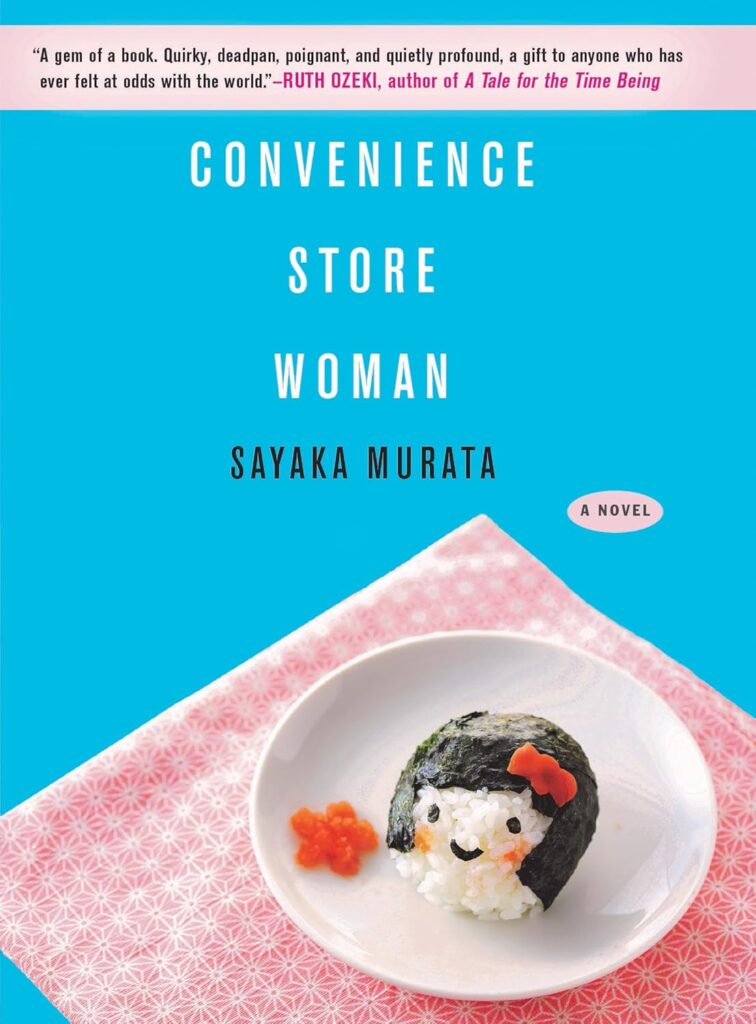
This sort of quest forms the story line of Sayaka Murata’s Convenience Store Woman2. Whether Murata intended to portray her protagonist Keiko Furukura as an Aspie or not, Keiko’s escapades will ring a bell with many Aspies, who a are likely to find this a very funny book.
Let’s start with Keiko’s desire to simply be a “cog in the machine,” a desire that would represent the very quintessence of anathema to most normies (Aspie shorthand for those who are neurotypical). Who would ever wish for such an awful fate?
I’ll tell you who in a minute. But first we need to talk about exactly what sort of cog Keiko is referring to. To a normie, the term conjures up the image, well, of a cog — rotating through mindless tasks with meaningless impact — no way to live a life.
But that is not what Keiko means by “cog.” To Keiko, the cog is a gear smoothly meshing with other gears as they cooperate in their rotational duties to accomplish some small but essential task as smoothly and effortlessly as possible. Keiko’ desire is to succeed in a job that requires little more than a simple set of “restricted, repetitive patterns of behavior,” another diagnostic indicator for ASD.
Being a successful cog also requires social interactions that are commensurately smooth. It’s this social smoothness that Keiko longs for — the ability to emulate typical human behavior sufficiently to grease the wheels and mesh effortlessly with the normies. As Keiko puts it …
At that moment, for the first time ever, I felt I’d become a part of the machine of society. I’ve been reborn, I thought. That day, I actually became a normal cog in society.
The novel teems with vignettes describing Keiko’s stratagems to align with the normie milieu. Learning to mimic the vocabulary and voice inflections of her co-workers. Discovering their favorite shops so she can buy similar fashions. Forcing herself to go to social gatherings where she studies the patterns of normie interaction in minute detail.
Keiko doesn’t run on emotion. Her reactions are analytic and emotionally neutral. She is puzzled by the strong reactions of others. But she quickly learns to add similar expressions indicating surprise, shock, or even outrage to her mimetic repertoire.
Her copycat behavior is immediately recognizable to most Aspies, who are likely to chuckle in recognition. “Fake it till you make it” is the order of the day. This exact recommendation, in so many words, is frequently offered by therapists to their Aspie patients. I’ve occasionally been the recipient myself.
But despite the strenuous exertions in her quest for normality, there are two salient characteristics of her situation that cannot be resolved so easily — the lowly economic status of her part-time convenience store employment, and the fact that she is not married. Elevating her economic status, or establishing herself as a respectable married woman would provide her with the cover story she needs to establish a solid position in her social circle.
But her job at the combini (convenience store) is something she is quite happy with. She has invested a lot of time in figuring out the rules. She follows them with gusto. She has no intention of giving up what she has worked so hard to earn.
The second of these conditions — her un-partnered domestic life — is the one that she decides to fix. A man named Shiraha gets a job at the combini. He is a strange fellow. Obsessed with finding a woman, he stalks customers he is attracted to, but is rude to anyone who fails to spark his interest, Keiko included. And he is constantly spouting a low-budget version of evolutionary biology:
The youngest, prettiest girls in the village go to the strongest hunters. They have the strongest genes, while the rest of us just have to content ourselves with what’s left.
Shiraha is easily identified as an incel (involuntary celibate), although the translator does not use this word. Try as he might, he cannot seem to manage to find a partner. Keiko, in contrast, appears to have no desire for romance, sex, or even much companionship, as hinted at by the absence of gender in the book’s Japanese title (コンビニ人間 – combini person). Bodily functions seem distasteful to her, as they might to a young eight- or nine-year-old girl.
Keiko is clearly not attracted to Shiraha. But neither is she as repelled as others might be, due in part to her attenuated capacity for emotional response. Viewing the situation analytically, she senses something of a win-win opportunity. Shiraha clearly cannot take care of himself, and Keiko can use some air cover in her struggle to appear almost normal. So she invites him to move in with her. This suits Shiraha just fine — he is not attracted to Keiko either, and has no designs on her. He need not fear a messy entanglement.
Once Shiraha moves in with her, a fundamental truth about neurodiversity is revealed. As long as you are well outside the pale, people will tend to leave you alone. There is nothing to be done with you. But when you move closer to the boundaries of normality, a surprising new dynamic emerges. People come out of the woodwork with all sorts of hints and recommendations, attempting to push you further in toward the center, where secure and sustainable normality are found. Expectations have been raised, and your very proximity to the border of the category represents a threat to its solidity. Keiko recognizes this …
The normal world has no room for exceptions and always quietly eliminates foreign objects. Anyone who is lacking is disposed of.
In a series of comic episodes worthy of Oscar Wilde, the busybodies descend. Keiko’s own sister shows up unannounced. Then Shiraha’s sister-in-law, whose husband was forced to pay Shiraha’s delinquent rent in his previous abode, appears, also unannounced, in hopes of recovering the funds. What these women discover brings them to tears. This is no “relationship” at all, but something more akin to outright fraud, as they see it.
Keiko and Shiraha’s win-win proposition has turned out to be a Faustian bargain, as the pressure increases on the pair to at least rectify that other outstanding sore point, Keiko’s lack of economic status. Yielding to the pressure, Keiko quits the convenience store, upgrades her wardrobe, and begins the search for a “real job.”
The climactic moment approaches as Keiko enters an office building where her first real job interview will take place. Along the way, she passes another combini, with its familiar sounds and well-rehearsed choreography.
Her choice is stark — the combini represents who she is, the fate she has been dealt in life, with which she has made her peace. The job interview represents entrée to normality, or at least the appearance of normality. Something must be sacrificed. Only one road can be taken.
Trying to understand Murata’s story, one might be tempted to invoke Joseph Campbell. It’s the Hero’s Journey once again, albeit in a “small ball” incarnation — Keiko as a Japanese version of Leopold Bloom, striving to meet the challenges of everyday life with pluck and humor. Does her final test represent a victory? Or a crushing defeat?
However, the questions raised by this story go beyond the individual’s predicament. Are Aspies really among the problem children of society? Or are they simply a special sort of person whom we should support and treasure, rather than denigrate with our menagerie of epithets, such as geek, nerd, tool, or dweeb? Perhaps they are among us for a reason. Perhaps we need them. Perhaps, just perhaps, we cannot do without them. Et tu, Albert? Et tu, Wolfgang? Et tu, Vincent?
Perhaps there are more of them, far more of them, than we imagine. Perhaps we can each remember our own difficulties learning the social cues of normality. Perhaps we have each had to “fake it till we make it” in some area of our life. Perhaps, in other words, we are all “on the spectrum” somewhere. The two million readers who are reported to have purchased this book may just be offering us a clue.
Notes
- American Psychiatric Association; Diagnostic and statistical manual of mental disorders (5th ed.); 2013. ↩︎
- Murata, Sayaka; Convenience Store Woman; translated by Ginny Tapley Takemori; Grove Press, New York, 2016. ↩︎