
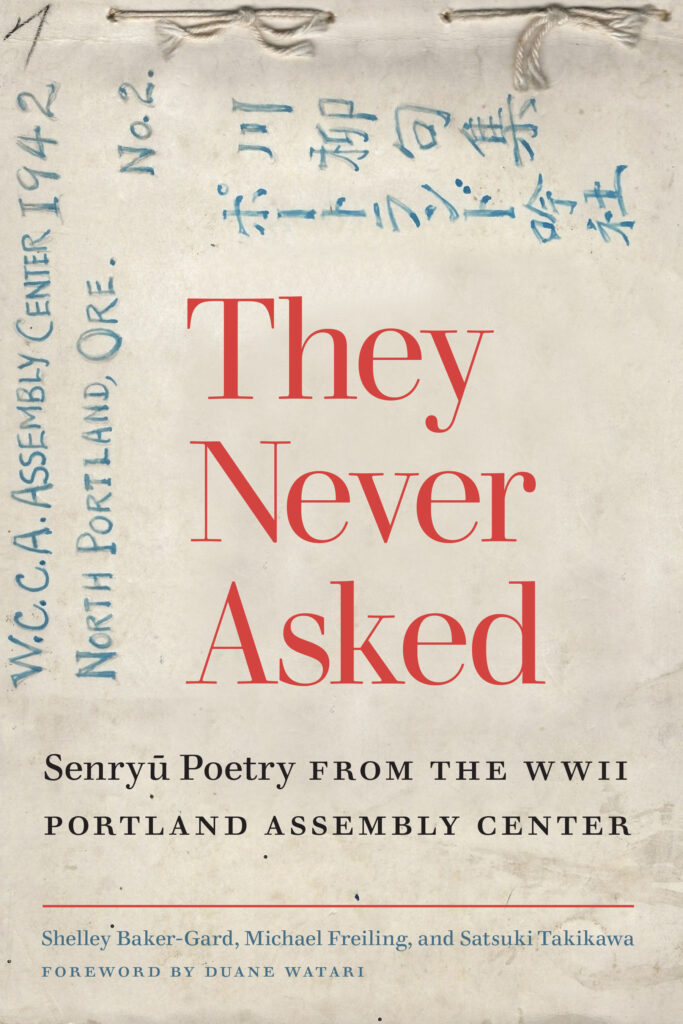
In early 2018, Shelley Baker-Gard walked into my office with a manuscript that her friend Duane Watari had discovered in his mother’s attic. As we looked it over, we began to realize what we were holding in our hands — a secret transcript of sessions held in August 1942 at a livestock exhibition all euphemistically dubbed the “Portland Assembly Center,” where Japanese Americans from the Pacific Northwest were rounded up before being transported to the camps farther inland. The conditions they faced were horrific, such as wooden floors impregnated with livestock dung and flies swarming in the hot summer months.
The sessions had been organized by Masaki Kinoshita (Duane’s grandfather) and Hisako Saito to help boost the morale of the incarcerated Japanese Americans, allowing them to write short senryu poems (similar to haiku) to vent their frustrations, build a sense of community, and maintain their equilibrium amid the horrors of life in what was essentially a concentration camp. Kinoshita was forced to surreptitiously transcribe the poems, because the prisoners were forbidden to possess any material written in Japanese.
Some of the poets had already developed a reputation in the Pacific Northwest. Others were newcomers. Their poetry focuses on many topics, including everyday life, anger and frustration, humor and irony, acceptance, and looking forward with hope. But all of it packs a powerful emotional punch.
Holding the manuscript in my hands, three thoughts crossed my mind in quick succession. First, this was a piece of real history. Second, it was coming to me for a reason — because the story needed to be told. Third, you simply don’t say no to history. So I knew, even before Shelley asked, that I would have to say “yes” to helping translate the poems.
My wife Satsuki and I translated a selection of the poems, which form the core of the book. Shelley helped to polish them and also added a significant amount of background material about the poets of the Assembly Center and the incarceration itself. I added an additional chapter on the challenges of translating Japanese poetry into English.
The perseverance of these Japanese Americans in the face of what they faced is an inspiration to us all, and a tribute to the resilience of the human spirit.
Related Links