
If you were to make a list of those rare periods in human history which saw a flowering of art and culture so remarkable that it left its imprint on the world stage for centuries after, what episodes would make your list? The Athens of ancient Greece, I wager, along with Renaissance Italy. Elizabethan England, perhaps. The salons of Paris during the Enlightenment. Or maybe Vienna during the reign of Maria Teresa, or the intellectual fermentation of its coffee houses in the fin de siècle.
Chances are that however long your list, the Kyoto of the Heian Period would not appear. And yet, for many reasons, this remarkable period is just as worthy of our appreciation and understanding. The Heian Period saw a flowering of literary culture unlike any in the world. Everyone at the Heian Court was expected to be a competent poet, and the women often outshone the men in their wit as well as the quality of their verse. The era had its share of remarkable characters, from emperors to Buddhist monks, from celebrated lovers to tragic figures.
Tens of thousands, perhaps hundreds of thousands of poems were written in this period. The highly selective imperial anthologies alone record over 9,900 of them. Yet among this vast number, a single anthology of 100 poems, the Hyakunin Isshu, is considered by many to be foundational. It forms the basis for education in classical Japanese poetry all over the country. As adults, most Japanese are still able to remember and recite one or two of their favorites. There is even a card game children and whole families play at New Year’s to test their memory of the poems.
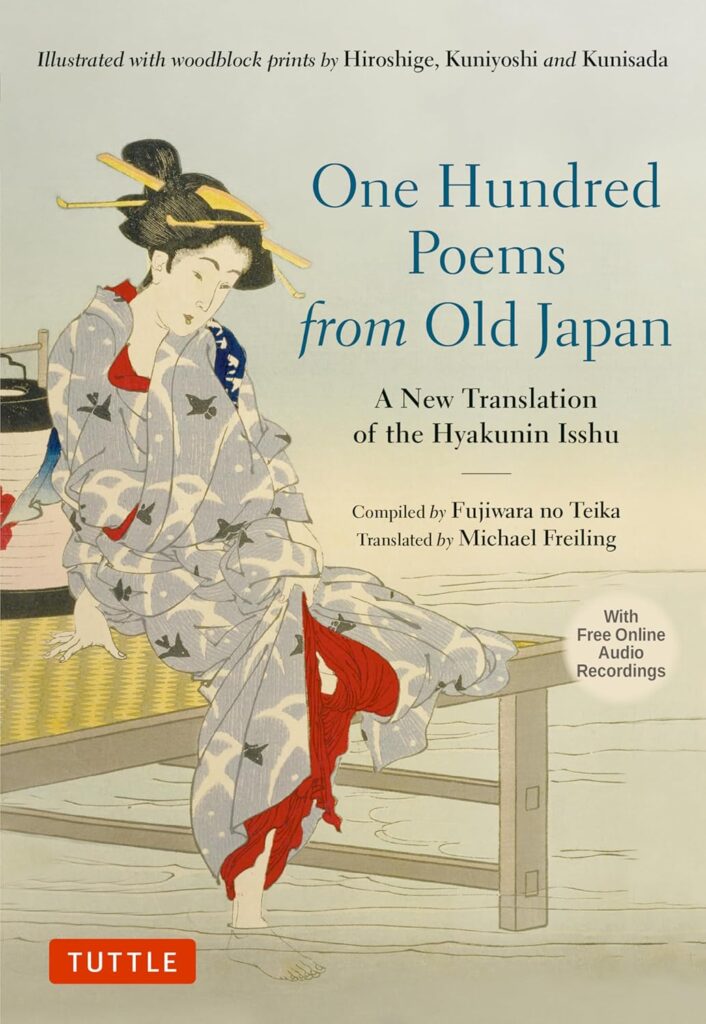
This translation of the Hyakunin Isshu was some 46 years in the making. The first draft was completed in 1978 as a Luce Scholar at Kyoto University. Some poems have stayed more or less the same over the years, while others have undergone significant revision. Some have appeared in literary journals. Now, Tuttle is publishing the entire collection as a beautiful hard cover gift edition, lavishly illustrated with 19th century woodblock prints to accompany each poem. You only have to hold the book in your hand to realize that this is a substantial volume.
The anthology begins with the flowering of classical Japanese literature in the Nara Period of the early 7th century, continues through its high point in the Heian Period from about 950 to 1050, and ends in the early 13th century as courtly life yields to the age of the samurai — some 350 years of conflict and turbulence.
The poets of the Hyakunin Isshu include Ariwara Narihira and Ki no Tsurayuki, who set the standard for the development of the waka poetic form, as well as the brilliant women of the Heian Period, Lady Murasaki (author of the Tale of Genji) and her arch-rival Sei Shonagon. It culminates in the tragic figures of the early Kamakura era, such as Emperor Go-Toba and Sanetomo, last of the Minamoto who wrested control from the Heian court and gave birth to the era of military rule by a succession of shoguns, only to be betrayed by his own grandfather.
In just one hundred poems, you can see a panorama of history and poetic style spanning nearly 600 years. Meet some of the most colorful figures of Japanese literature through their own self-expression. Appreciate the deep spiritual insights of the Buddhist monks. Enjoy the exuberant romance of the high Heian Period. And share the sense of foreboding that builds as the era reaches its ultimate conclusion.
If you want to understand the roots of Japanese literary sensibility, as well as the uniqueness of the Japanese worldview, this is the place to start.